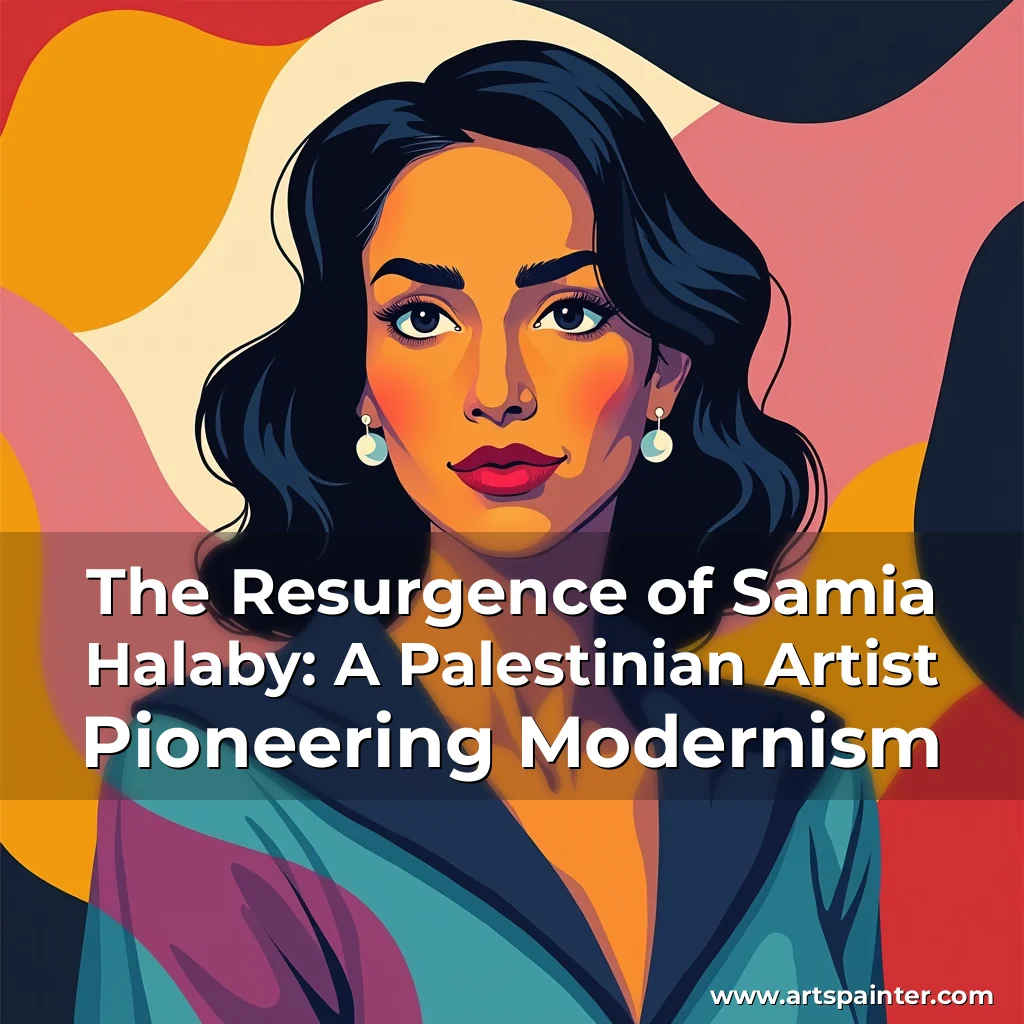
The art world has witnessed a remarkable resurgence in the market value of Samia Halaby, a Palestinian American artist who has been active in the field since 1959. Her work, which encompasses painterly abstractions and computer-inflected experiments, has seen a sharp increase in institutional attention and market value over the past decade.
The most recent example of this trend is the sale of her 2013 painting “Water Lilies” at Christie’s in May 2022, which fetched $138,600 – more than three and a half times its previous result. This performance was not an outlier, as Halaby’s top 10 auction results have been dominated by sales in the past three years, including three in 2022.
- Eight of Halaby’s top 10 auction results have been set in the past three years.
- Eleven of her works have cleared the six-figure threshold at auction, most within the same time frame.
The institutional momentum behind Halaby’s success is evident in her first US museum survey, which opened last year at Michigan State University’s Eli and Edyth Broad Art Museum. The exhibition was initially planned for the Eskenazi Museum of Art at Indiana University but was cancelled due to unforeseen circumstances.
| Exhibition | Location | Year |
|---|---|---|
| Sharjah Art Museum | Sharjah, UAE | 2023 |
| Museum of Modern Art | New York, USA | 2023 |
| Kunsthalle Wien | Vienna, Austria | 2023 |
| Mudam | Luxembourg | 2023 |
Halaby’s work has been gaining attention for its prescience, particularly in the 1980s when she experimented with digital tools. Her computer-generated works, which were created on early Apple computers, are now being recognized for their innovative use of technology.
“Female artists like Halaby and Etel Adnan are finally being recognized not only as participants but as pioneers of modernism in the region,” Noor Soussi, head of Bonhams’s modern and contemporary Middle Eastern art sales, said via email.
Experts believe that Halaby’s rise is part of a broader trend in the art market, where collectors and institutions are seeking to diversify their holdings and recognize the contributions of underrepresented artists. The Centre Pompidou’s acquisition of three of Halaby’s computer-generated works in 2022 is a prime example of this shift.
“She was so early in being interested in the power of the computer,” said Marie-Claire Thijsen, associate director of postwar and contemporary art at Christie’s. “Her digital works are finally receiving the attention they deserve.”
Christie’s has conducted multiple private sales of Halaby’s work, both to major institutions and top-tier private collectors. The company’s Thijsen believes that the market is increasingly drawn to artists who have shaped modernism on their own terms, and Halaby is firmly among them.
“The market is increasingly drawn to artists who have shaped modernism on their own terms, and Halaby is firmly among them,” Thijsen added. “With several important consignments lined up for the autumn season, including works by key Arab female modernists, we anticipate her market will continue to strengthen as collectors and institutions further recognize the depth of her work.”
Experts predict that Halaby’s momentum will continue, driven by advances in digital art, blockchain, and artificial intelligence. Yassaman Ali, Phillips’s regional director for the Middle East, believes that Halaby’s digital works are key to her growing legacy and renewed relevance.
“Perhaps, you can say we have finally collectively caught up with Samia Halaby’s thought process as she has always been so forward-thinking,” Ali said. “Maybe that is why we are finally able to appreciate her for who she is.”
The art world’s recognition of Halaby’s contributions is a testament to the power of diversity and inclusion in the art market.

news is a contributor at Arts Painter. We are committed to providing well-researched, accurate, and valuable content to our readers.
Table of Contents