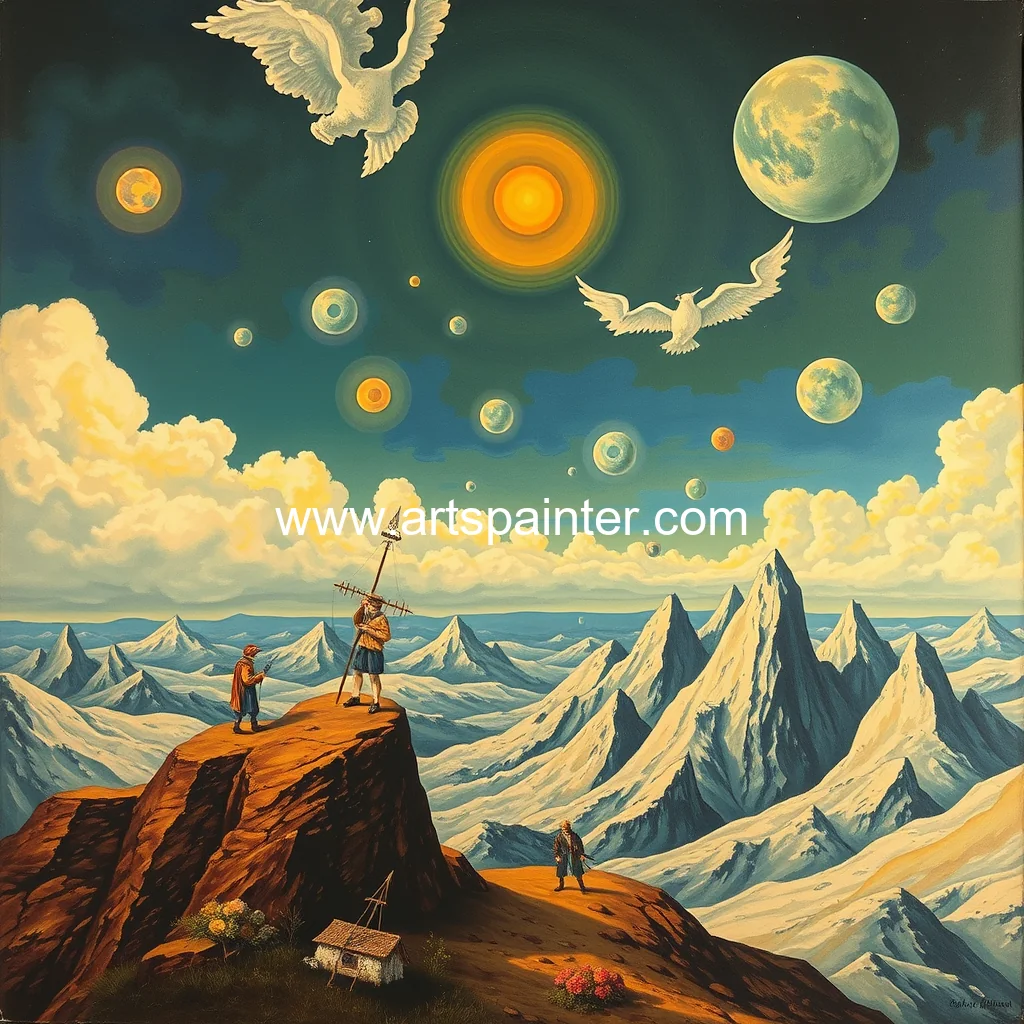
This foundational text of the Surrealist movement laid the groundwork for a new way of thinking about art, literature, and the human experience. In this article, we’ll delve into the key principles and ideas that defined the Surrealist movement, and explore how its influence can still be seen today.
Table of Contents
The Origins of Surrealism
Surrealism emerged in the early 20th century, primarily in France, as a response to the societal and cultural norms of the time. The movement was born out of a desire to challenge the conventional boundaries of art, literature, and the human psyche. Breton’s manifesto served as a rallying cry for artists, writers, and thinkers who sought to break free from the constraints of rationality and logic.
The Principles of Surrealism
At its core, Surrealism was a movement that celebrated the power of the subconscious and the irrational. The Surrealists believed that the human mind was capable of accessing hidden realms of creativity and imagination, and that these realms could be tapped into through various forms of artistic expression.
The Surrealist Movement: A Brief History
The Surrealist movement emerged in the 1920s, primarily in Paris, as a response to the societal norms and conventions of the time. The term “Surrealism” was coined by French writer Guillaume Apollinaire in 1917, but it wasn’t until the 1920s that the movement gained momentum. The core idea of Surrealism was to explore the subconscious mind and the world of dreams, challenging the rational and logical thinking of the time.
Key Figures and Influences
Some of the most influential figures in the Surrealist movement include:
The Exhibition at the Pompidou Center
The Surrealist exhibition at the Pompidou Center in Paris is a unique opportunity to explore the works of these influential artists and gain a deeper understanding of the movement’s core principles.
This global phenomenon is a testament to the power of art to transcend borders and cultures.
The Origins of Surrealism
Surrealism emerged in the 1920s, primarily in France, as a response to the societal norms and conventions of the time. The movement was founded by André Breton, a French writer and poet, who sought to challenge the rational and logical thinking that dominated the art world. Breton’s manifesto, “The Surrealist Manifesto,” published in 1924, outlined the movement’s core principles, including the power of the subconscious, the importance of dreams, and the blurring of reality and fantasy. Key principles of Surrealism: + The power of the subconscious + The importance of dreams + The blurring of reality and fantasy + The use of automatism (unconscious creative process)
The Global Phenomenon of Surrealism
While Surrealism originated in France, its influence soon spread to other parts of the world.
The exhibition aims to promote the art movement’s relevance in contemporary society.
The Surrealist Movement: A Legacy of the Unconventional
The Surrealist movement, born in the early 20th century, was a revolutionary art movement that sought to challenge the conventional norms of art, literature, and culture. At its core, Surrealism was a reaction against the rationalism and logic of the time, embracing the irrational, the subconscious, and the fantastical. This movement, which would go on to influence countless artists, writers, and thinkers, continues to captivate audiences with its unique blend of the bizarre and the beautiful.
The Art of Surrealism: A World of Dreams and Nightmares
Surrealist art often features dream-like scenarios, where the rational and the irrational coexist in a world of contradictions. Artists like Salvador Dalí and René Magritte pushed the boundaries of representation, creating works that were both thought-provoking and visually stunning. Dalí’s iconic “The Persistence of Memory” features melting clocks, while Magritte’s “The Treachery of Images” depicts a pipe with the caption “Ceci n’est pas une pipe” – a clever subversion of the relationship between representation and reality.
The Exhibition at the Pompidou Center: A New Generation Engaged
The Pompidou Center’s upcoming exhibition of Surrealist works is a significant event in the art world.
The exhibition, titled “Surrealism: The Art of the Impossible,” explores the movement’s history, philosophy, and artistic expressions.
The Origins of Surrealism
Surrealism emerged in the 1920s as a response to the trauma and disillusionment of World War I. The movement’s founders, including André Breton, Guillaume Apollinaire, and Paul Éluard, sought to challenge the rational and logical worldviews that dominated Western culture at the time. The term “surrealism” was coined by Breton in 1924, derived from the French word “sur-réalisme,” meaning “beyond realism.”
The Philosophy of Surrealism
Surrealism’s philosophical underpinnings were rooted in the concept of the “uncanny” and the idea that the rational and irrational coexist in the human psyche. The movement’s emphasis on the subconscious and the irrational was influenced by Sigmund Freud’s psychoanalytic theories.

news is a contributor at Arts Painter. We are committed to providing well-researched, accurate, and valuable content to our readers.